
WhatsApp reminders for dental practices: the recall-cycle playbook
Hygiene every six months, perio maintenance every three, restorative follow-ups at two weeks. A five-step WhatsApp recall playbook that keeps a dental chair full without a Saturday phone-bash.
 by Nacho Coll
Nacho founded Zellbox to give appointment-driven small businesses — clinics, salons, spas, physio, aesthetics, vets, mental-health, and fitness studios — a WhatsApp-first calendar and customer record system.
A typical private dental practice runs three concurrent recall cycles on every patient:
- 6-month hygiene cleaning — the baseline, on most adult patients.
- 3-4 month perio maintenance — for periodontal-treatment patients.
- 2-week post-op follow-up — after extractions, implants, root canals, restorative work.
Each one fails differently. Hygiene patients drift off after 12-18 months of silence. Perio patients miss their tightest cycle and the disease comes back. Post-op patients skip the follow-up because they “feel fine” — and the practice loses the verification step that catches early complications.
A practice that runs the recall cycle on paper or in a desktop scheduler loses 15-25 % of hygiene appointments to silent no-shows — the steady-state range we see across dental workspaces on Zellbox. On a €100 hygiene visit that’s €1,500-2,500 per dentist per month. Multiply by three full-time chairs and the practice leaks €54,000-90,000 a year — without anyone noticing because the appointment slots get backfilled by new patients who book reactively, not proactively.
The fix isn’t more marketing. It’s a disciplined WhatsApp recall protocol that runs on the patient’s calendar without a receptionist remembering to dial.
Why dental no-shows are different
Three operational patterns specific to dentistry that you don’t see in other verticals:
- The “I feel fine” recall. Hygiene + maintenance visits are preventive. A patient with no symptoms feels no urgency. Six months passes and the recall slot is open but the patient hasn’t booked. The practice doesn’t notice until the chair sits empty on Friday morning.
- The recurring-cycle drop-off. A perio-maintenance patient on a 3-month cycle will skip one visit and stop entirely. The next time they call, it’s eight months later, an acute abscess, and a much harder treatment plan.
- The post-op silent disappearance. After an extraction, the patient googles “implant healing” instead of coming back at the 2-week mark. Your follow-up window closes, and if there’s a complication you find out at the next emergency visit — not at the scheduled check.
Public-health analyses of dental no-shows consistently land in the 8-23 % range depending on the patient cohort. Private-pay sits at the lower end; mixed private/public and fully public-funded clinics at the higher. Across both, the lever that moves the no-show rate the most is structured pre-visit reminders — not penalty fees, not deposits, not anything else.
Why WhatsApp wins for the dental recall
Three reasons WhatsApp beats SMS and email for the dental recall specifically:
- The 6-month gap problem. SMS reminders sent every month feel like spam. A single WhatsApp message a week before a 6-month recall feels like service. The medium absorbs the cadence.
- The “book a slot back” reply flow. The patient taps “Book” inside the WhatsApp template, and the practice’s front desk sees the request in the same shared inbox they answer the next call from. No callback queue.
- The post-op photo loop. Many post-op questions are visual — “is this normal?” with a photo of the surgical site. SMS can’t carry it; email feels heavy; WhatsApp is what the patient already uses to message their family doctor and feels appropriate.
In practice, a proper protocol pushes hygiene-recall booking rates from the typical 55-65 % range up to 85-90 % within six months. On a 1,200-patient practice that’s an extra 240-300 hygiene visits a year — €24,000-30,000 of recovered revenue before any treatment up-sell.
The five-step recall playbook
1. Define the three recall windows in the calendar, not in someone’s head
The receptionist’s notebook is where recall dies. The Google Calendar event with a recurrence rule is where it lives.
- 6-month hygiene: book the next slot in the calendar at the end of every visit, not “we’ll call you in six months.”
- 3-month perio maintenance: same rule — the next maintenance slot is booked before the patient leaves the chair.
- 2-week post-op: booked at the same time as the procedure itself, with the post-op follow-up as a linked calendar event.
When the recall window is a real calendar event with a real time, the reminder system has something to fire against. When it’s a sticky note that says “Call Jenny in March,” recall depends on whoever answers the phone that morning remembering to look at the sticky note.
2. Send exactly two reminders. Not five. Not one.
The reminder cadence that works in dentistry is the same that works for physio, aesthetics, and vet:
- 7 days before — the patient has time to reschedule if life intervened.
- 24 hours before — last-call reminder for the ones who let it slide off the radar.
Three or more reminders are spam in Meta’s quality-rating system. Your template gets downgraded across the entire patient base — not just the one who didn’t reply. One reminder is too few because the 7-day notice catches reschedules but misses the “I forgot” cohort.
3. Capture written consent — not a ticked box
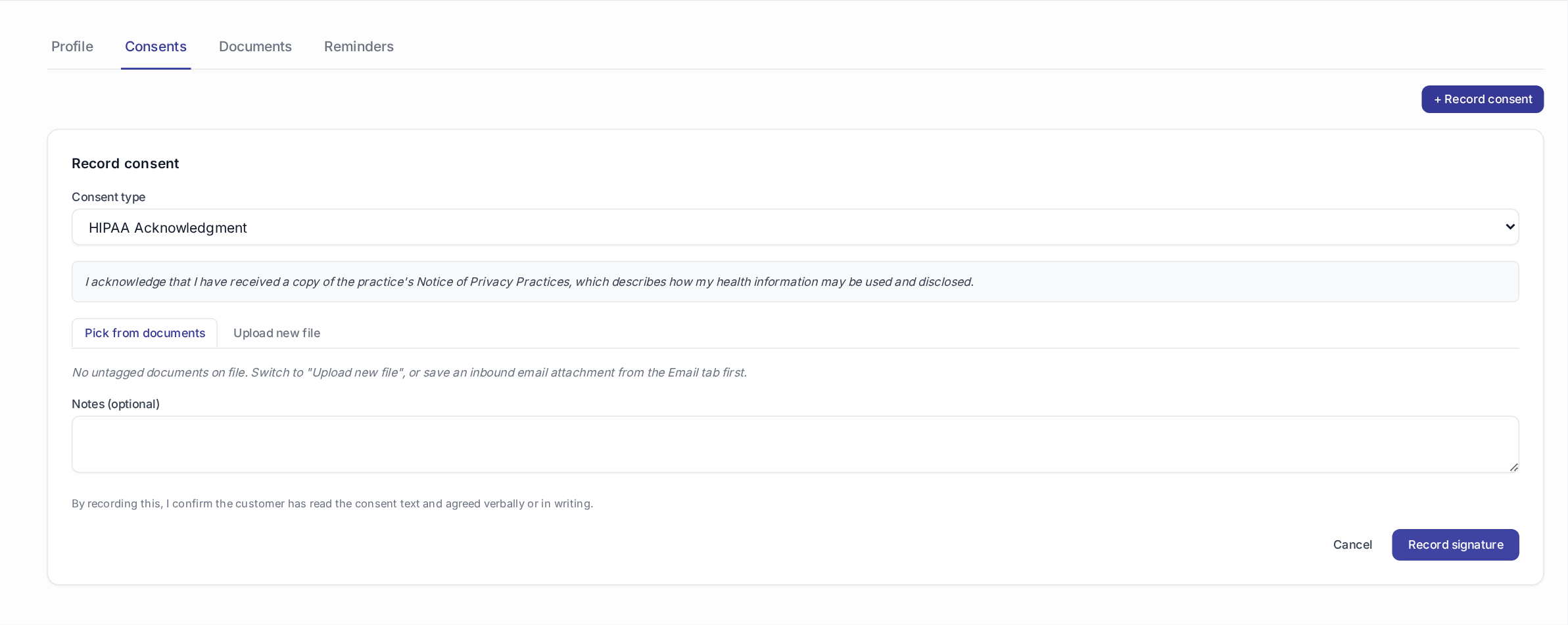
GDPR + HIPAA + LOPDGDD (and equivalent regimes globally) treat dental recall messages as operational communication, not marketing. But they still require explicit, demonstrable consent. A ticked box on the intake form survives most inspections; a signed PDF in the patient file is what auditors expect to see.
In Zellbox, consent is a first-class concept:
- Your administrator defines consent types once (“WhatsApp recall reminders”, “Data processing under GDPR”, “Marketing communications”).
- For each patient, send the document from their file by email or by WhatsApp. The patient signs with a fingertip on their phone and returns it.
- The signed PDF is stored in the patient file as evidence — timestamped, auditable, retrievable for any future inspection.
- The reminder system reads the consent state on every appointment. No signed consent, no reminder fires. Zero room for human error.
4. Use a Meta-approved template, not a hand-typed one
The WhatsApp Business API requires pre-approved templates for outbound messages outside the 24-hour service window. For dental recall, the template Zellbox ships from day one looks like:
Recall — appointment reminder for Sarah
Hi Sarah,
Your hygiene appointment with Dr. Williams is scheduled for Friday, July 4th at 9:30 AM. 📍 14 High Street
See you then.
— Sent by Zellbox
The variables (name, service, practitioner, date and time, address) fill from the Google Calendar event and the patient file. The front desk writes nothing. When you register your own branded template with Meta, swap “hygiene appointment” for the exact recall type and the address for your practice — the structure stays.
5. The unbooked-recall sweep
The hardest discipline in the playbook: a weekly sweep of patients who SHOULD have a recall booked but DON’T.
Open the patient list filtered by “last visit > 5 months ago AND no upcoming appointment.” Every name on that list is a recall slot that the front desk needs to chase. In Zellbox, the customer list supports this filter directly — you set up the saved filter once and run it every Monday morning. Then the front desk sends a templated WhatsApp message to each name on the list (“Hi Sarah — it’s been six months since your last cleaning. Here are two slots that fit your usual Friday morning…”) and books from the replies.
This is the single highest-leverage activity in a dental practice’s revenue cycle. The patients on the list are already yours — they’ve come before, they trust the dentist, they need the visit clinically. They just haven’t booked. Five minutes of templated WhatsApp on Monday morning recovers the entire week’s empty hygiene slots.
Errors that cost dental practices money
A few patterns we see when practices come from a paper-and-phone recall system:
- The recall list lives in the receptionist’s head. When she goes on holiday, the recall stops. When she leaves, the list leaves with her. Make the recall list a saved filter in the system, not a memory.
- Reminders sent from the receptionist’s personal WhatsApp. Fine for 5 patients a day. With 40 appointments a day it breaks — and when she’s off, nobody can read the replies. There’s also no audit trail for the regulator.
- No-shows treated as bad luck, not as data. Three no-shows in a row from the same patient is a signal — they’ve moved practices, they’ve lost the slot in their head, or they need a phone call before the next online booking. A practice management system that doesn’t surface that pattern leaves money on the table.
- The post-op follow-up booked verbally, not in the calendar. “Come back in two weeks” turns into “I’ll call to schedule” turns into “I forgot.” The follow-up has to be a calendar event from the moment the patient leaves the chair.
How Zellbox handles the five steps
Every step above is wired into Zellbox by default:
- The two reminders fire automatically at 7 days and 24 hours before every appointment in your Google Calendar.
- Consent documents send from the patient file, signed PDFs save as evidence, and reminders only fire to patients with consent on file.
- A Meta-approved template ships on day one — swap it for your branded version when Meta verifies it.
- Rescheduled appointments reprogram their reminders automatically when you drag the slot in the calendar.
- The unbooked-recall filter is a saved customer-list view your team runs every Monday morning.
Setup takes about 12 minutes: 2 to create your Zellbox workspace and 10 to connect your WhatsApp Business number through Meta’s Embedded Signup.
→ Start free with Zellbox (Starter is free forever, no card required) → Full dental-sector page: /clinics-dental/ → Sibling post: GDPR + HIPAA checklist for clinics: 12 audit points → The CRM that unifies WhatsApp, Gmail, and Google Calendar: zellbox.com
The bottom line
Dental recall is not a marketing problem. It’s a calendar discipline problem: the next visit must be a real event in a real calendar before the patient leaves the chair, the reminders fire automatically at the right cadence, and a weekly sweep catches the names that slipped through. Do that and a 1,200-patient practice recovers €24,000-30,000 a year of hygiene revenue without buying a single new patient.
If you’d rather have the protocol running on rails than tracked in a spreadsheet, that’s what Zellbox is for.
About the author: Nacho Coll is the founder of Zellbox. He writes about automating WhatsApp Business workflows for visit-driven small businesses — clinics, salons, vets, fisio, aesthetics, dental.
About the author
Nacho Coll
Founder & Engineer at Zellbox
Nacho founded Zellbox to give appointment-driven small businesses — clinics, salons, spas, physio, aesthetics, vets, mental-health, and fitness studios — a WhatsApp-first calendar and customer record system. Writes about WhatsApp Business automation, no-show economics, recall-cycle playbooks, and the operational realities of running visit-driven businesses at scale.