
Confidential WhatsApp flows for mental-health practices
Reminders that name the time, never the diagnosis. The protocol that protects the patient relationship while cutting no-shows without damaging trust.
 by Nacho Coll
Nacho founded Zellbox to give appointment-driven small businesses — clinics, salons, spas, physio, aesthetics, vets, mental-health, and fitness studios — a WhatsApp-first calendar and customer record system.
A psychology or counselling practice running 25 sessions a week at €120 a session leaks real revenue to no-shows when reminders are ad-hoc — revenue the practitioner cannot reclaim by working harder because the calendar is already full. The bottleneck is the appointment, not the therapist.
The channel question is uniquely sensitive in mental health: SMS reminders feel impersonal, phone calls intrude on a workday, and email is ignored. WhatsApp is what the patient already uses with everyone else in their life. But the message must say less, not more — the reminder names the time, the date, and the practitioner, and never anything else.
This post is the confidential-reminder protocol we run with every mental-health practice that starts on Zellbox.
Why mental-health no-shows fail differently
Three patterns specific to psychology and counselling practice:
- The session itself is the threshold. A patient with depression or anxiety often has the hardest time the morning of the session. A well-timed reminder is a nudge across that threshold; a poorly-timed one is a trigger for cancellation. The reminder must be matter-of-fact, time-only, not motivational.
- The phone is shared. Many adult patients share a phone with a partner, a parent, or a roommate. A reminder that says “Your psychotherapy session is tomorrow” or “Your anxiety follow-up is in 2 hours” exposes the patient. The reminder must be readable by a third party without revealing the reason for the visit.
- The 50-minute hour can’t be backfilled. Unlike most other verticals, a 24-hour notice doesn’t help a mental-health practice fill the empty slot — the next patient on the list doesn’t pick up a slot mid-week. A missed session is gone; the only meaningful lever is preventing it.
Without structured reminders, mental-health no-shows are one of the practice’s largest silent revenue leaks. Customers running the protocol below typically see their no-show rate fall across the first couple of months — how much depends on the patient cohort, the reminder cadence, and how the practitioner handles the first-no-show conversation. If you’re weighing how strict to make enforcement, the no-show policy template library lays out consumer-friendly, balanced, and strict-deposit versions for comparison.
Why WhatsApp wins for mental-health reminders
Three reasons WhatsApp fits the channel constraint:
- The patient already uses it for low-stakes coordination. Confirming dinner with a friend, rescheduling with a doctor, talking to family. The mental-health reminder lands in the same medium with the same tone — it doesn’t feel clinical, doesn’t feel exposed, doesn’t feel out-of-the-ordinary.
- The patient replies on their own time. SMS replies feel urgent; phone callbacks feel like an interruption. WhatsApp replies can land 4 hours later and the practitioner sees the conversation at the start of the next day.
- The reply lands on the patient file, not on a phone. The practitioner sees the conversation history at the next session — without scrolling through a personal phone, without crossing professional/personal boundaries.
The five-step protocol
1. The template names the time, never the diagnosis
The single-most-important rule: the reminder template names the date, the time, the practitioner’s name, and the practice address. Nothing else. No “psychotherapy”, no “anxiety follow-up”, no “couples counselling”. Just:
Hi Sofia,
Your appointment with Dr. Lopez is tomorrow, Friday 4 July at 3:00 PM. 📍 14 Park Road
See you then.
— Sent by Zellbox
If a third party reads the patient’s WhatsApp — a partner, a parent, a roommate — all they see is “Sofia has an appointment with Dr. Lopez.” That’s it. The reason for the visit, the diagnosis, the treatment plan stay on the patient file inside the practice — never in a message body.
2. Two reminders. 24 hours and 2 hours.
The reminder cadence:
- 24 hours before — gives the patient the morning to rearrange their day if needed.
- 2 hours before — the last-call reminder for the threshold-crossing moment.
A third reminder is intrusive; one reminder is too few because the 24-hour notice catches reschedules but misses the “I forgot” cohort. Two is the right balance for mental health specifically — three feels like pressure.
3. Signed consent. Two documents, separately.
EU regimes (GDPR, LOPDGDD, RGPD-FR), the UK (DPA 2018), and equivalent regulators globally distinguish between operational communication and marketing. For a mental-health practice, this matters more than usual because the regulator’s audit checks specifically for clinical-context consent.
In Zellbox, the practitioner defines two consent types:
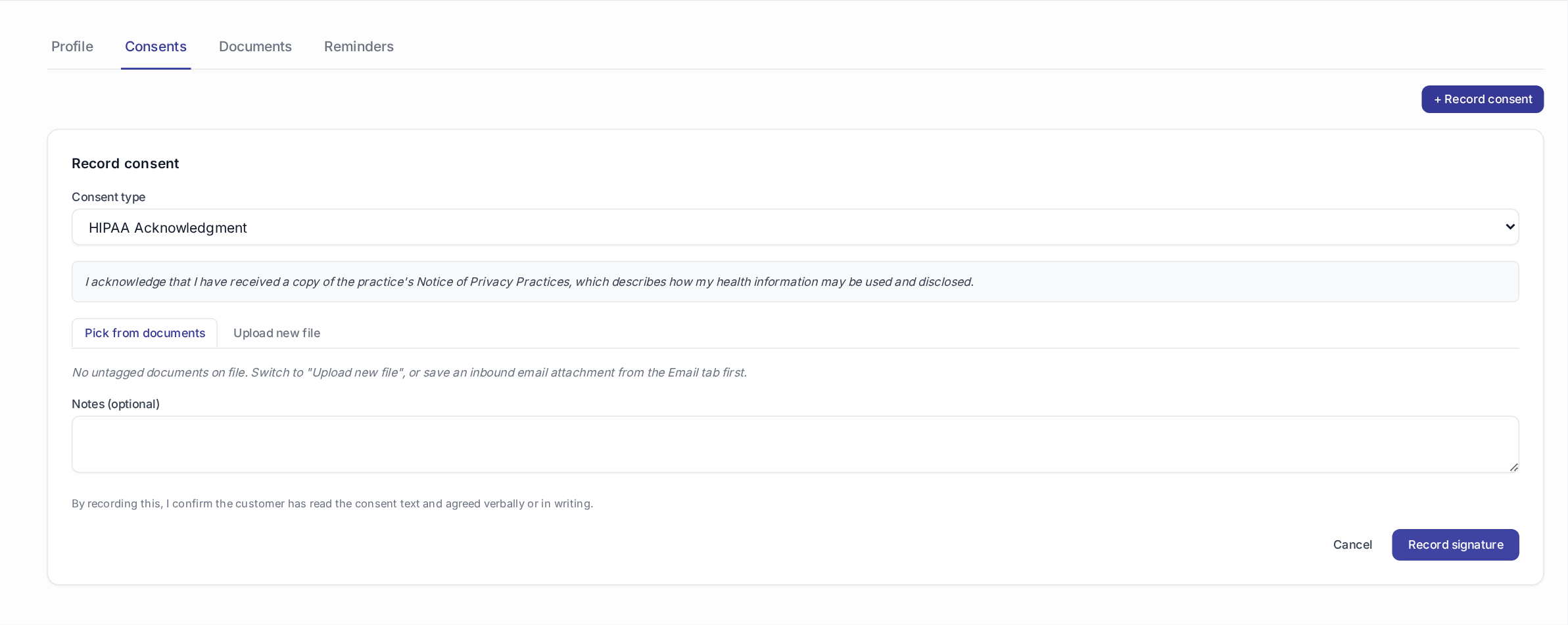
- Operational consent — for the appointment reminders. Mandatory for the protocol to run.
- Telehealth release / data processing — for the broader storage of conversation history. Often equivalent to the practice’s standard intake consent, captured during onboarding.
Each is a separate signed PDF on the patient file, timestamped, retrievable. When the regulator audits, both are produced from the same record without the practitioner having to dig through paper files.
4. The reply lands on the file, not on a phone
When the patient replies to the reminder — “I can’t make Friday, can we move to Monday?” — the message lands on their patient record in the shared inbox. The practitioner sees the message at the start of the next day, reschedules with one click, and the original session is released.
This is where the channel gets its second life. The phone-call equivalent (“I’ll listen to voicemail at 6 PM”) is a permanent context-switch for the practitioner. The shared inbox is a 30-second glance at the start of a clear hour.
5. The first-no-show conversation
Mental-health no-shows are a clinical signal, not just a calendar problem. A patient who silently misses a session is often telling you something about the work — the topic is too close, the rapport has wavered, the treatment plan is on the wrong track.
Zellbox flags any silent no-show on the patient record. The practitioner sees the flag at the start of the next-scheduled session and decides whether to address it directly with the patient (“I noticed we missed Friday — anything I should know about?”) or let it pass.
The practice never charges for the silent no-show with this patient cohort. The financial recovery from enforcement doesn’t compensate for the clinical-trust damage; the recovery comes from preventing the silent no-show in the first place via the reminder protocol.
Errors that erode the protocol
A few patterns to watch for:
- Templates that name the reason for the visit. “Psychotherapy session” / “anxiety follow-up” / “couples counselling” should never appear in message bodies. Audit your templates for this on day one.
- Reminders from the practitioner’s personal WhatsApp. Crosses the professional boundary, lacks the audit trail, and exposes the practitioner’s number to the patient’s network. Use a dedicated practice number through Meta Embedded Signup.
- Mixing operational and marketing into one consent doc. When the patient consents to “appointment reminders and promotional offers” as one tickbox, the operational reminders get reclassified as marketing in Meta’s quality system. The reminder reliability degrades across all patients.
- No flag on silent no-shows. Treating the missed session as a billing question instead of a clinical signal misses the real recovery — the patient’s relationship with the work, not the practice’s relationship with their wallet.
Practices running prepaid session bonos face a sharper version of this trade-off — see the 24h cancellation policy that protects a physio’s bono for the enforcement mechanics that keep a prepaid package profitable.
How Zellbox handles the five steps
Every step is wired in by default:
- The two reminders fire automatically at 24 hours and 2 hours before every session in your Google Calendar. The template names the time, never the diagnosis.
- Consent types are first-class: operational and data-processing consents are separate documents, each signed by the patient on their phone, each stored as a timestamped PDF.
- Patient replies land on the shared inbox tied to the patient file — never on a personal phone, never out of the practitioner’s view at the next session.
- Silent no-shows flag automatically; the flag surfaces on the patient record at the start of the next-scheduled session.
Setup takes about 12 minutes: 2 to create your Zellbox workspace and 10 to connect your WhatsApp Business number through Meta’s Embedded Signup.
→ Start free with Zellbox (Starter is free forever, no card required) → Full mental-health sector page: /clinics-mental-health/ → Sibling post: GDPR + HIPAA checklist for clinics: 12 audit points → The CRM that unifies WhatsApp, Gmail, and Google Calendar: zellbox.com
The bottom line
Mental-health reminders are an exercise in saying less, not more. Time, date, practitioner, address — and nothing about the reason for the visit. Two reminders at the right cadence, signed consent split across two purposes, replies landing on the patient file instead of a personal phone. Do that and the practice recovers real session revenue while strengthening the therapeutic relationship instead of damaging it.
If you’d rather have the protocol running on rails than enforced by an uncomfortable conversation, that’s what Zellbox is for.
About the author: Nacho Coll is the founder of Zellbox. He writes about automating WhatsApp Business workflows for visit-driven small businesses — clinics, salons, vets, fisio, aesthetics, dental, mental health.
About the author
Nacho Coll
Founder & Engineer at Zellbox
Nacho founded Zellbox to give appointment-driven small businesses — clinics, salons, spas, physio, aesthetics, vets, mental-health, and fitness studios — a WhatsApp-first calendar and customer record system. Writes about WhatsApp Business automation, no-show economics, recall-cycle playbooks, and the operational realities of running visit-driven businesses at scale.