
Calendly vs Zellbox: which fits appointment-driven SMBs?
Calendly is a booking link. Zellbox is the operating system for the visit cycle — WhatsApp reminders, shared inbox, AEPD-grade consent. When does each one fit?
 by Nacho Coll
Nacho founded Zellbox to give appointment-driven small businesses — clinics, salons, spas, physio, aesthetics, vets, mental-health, and fitness studios — a WhatsApp-first calendar and customer record system.
Editorial note: I work on Zellbox, so this post has a natural bias. I’ve tried to describe Calendly as accurately as possible from their public pages as of June 2026. If you spot a factual error, message me on LinkedIn and I’ll fix it.
If you’re a clinic, salon, vet, or any appointment-driven small business looking at scheduling tools, you’ve almost certainly seen Calendly at the top of the funnel. It’s the default for “share a link, let people pick a time” — and millions of professionals use it that way.
Zellbox is a different shape of product. This post explains which of the two fits your situation, honestly.
The 30-second answer
Pick Calendly if:
- You sell knowledge work in scheduled blocks (consulting, sales calls, advisory, coaching, freelance professional services).
- Your customer books once and the deal is closed at the meeting.
- You don’t need WhatsApp confirmations — calendar invite + email are enough.
- You don’t need to track a customer’s full visit history, prescriptions, treatment cycles, or signed consents.
- Your “no-show rate” is acceptable as-is (typically <5% for B2B).
Pick Zellbox if:
- Customers come back repeatedly for a series of appointments (a 5-session physiotherapy bono, a 6-month vaccination cycle, monthly cleanings).
- Your no-show rate is 10-25% and each missed visit costs €35-450.
- Customer history needs to live somewhere structured (clinical notes, signed consents, treatment protocol, insurance status).
- You want WhatsApp reminders + confirmations that match the conversation patterns your customers actually use.
- You need GDPR / AEPD / LGPD / DSGVO-grade compliance built into the consent + record flow, not glued on.
The fundamental difference: booking link vs operating system
Calendly is a single-touchpoint booking link. The flow is: prospect arrives at your URL, picks a slot, calendar invite goes out, you both show up. Calendly’s job ends at “meeting confirmed”.
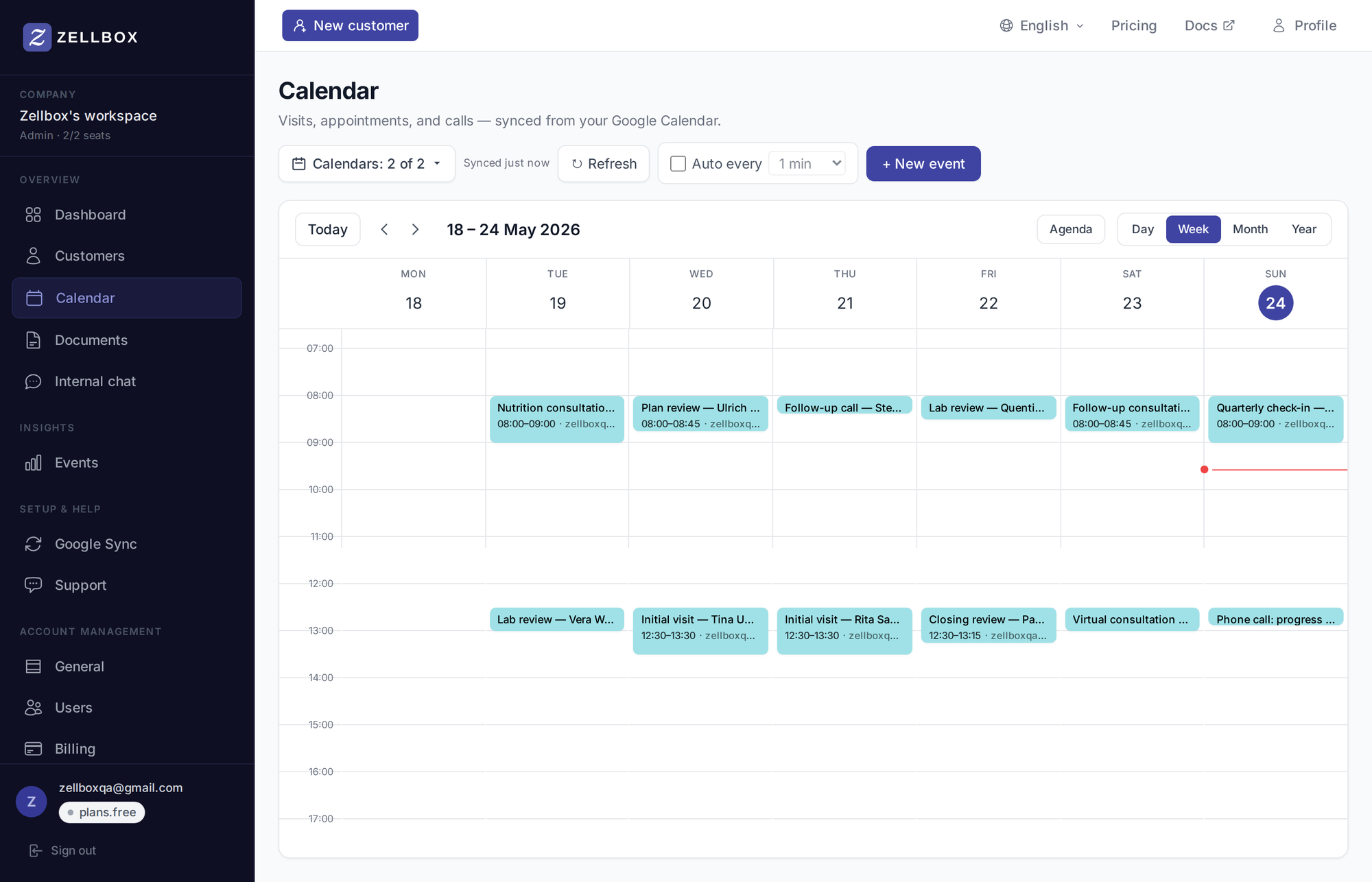
Zellbox is the operating system for the entire visit cycle. The flow is: customer is on file → next visit auto-scheduled per protocol → WhatsApp confirmation 24h before → in-clinic check-in → next visit auto-pre-scheduled per treatment protocol → WhatsApp follow-up 2h after → cycle repeats. Zellbox’s job is the full lifetime relationship.
That difference explains everything else:
- Calendly assumes the meeting is the product. Once it happens, the loop closes.
- Zellbox assumes the meeting is just a node in a longer chain. The customer comes back. The next visit needs to be scheduled. The reminder text needs to match the treatment context. The consent for the next session needs to be signed.
For knowledge work this distinction doesn’t matter — you book a sales call, you have it, the customer either buys or doesn’t.
For appointment-driven SMBs (clinics, salons, vets, fisio, aesthetics) the distinction is everything — the same customer comes back 5, 10, 50 times. The relationship is the asset, not the meeting.
Feature-by-feature comparison
| Feature | Zellbox | Calendly |
|---|---|---|
| Native WhatsApp Business API | ✅ Embedded Signup | ❌ — calendar invite + email only |
| Bidirectional Google Calendar | ✅ — native | ✅ — native (Calendly’s strength) |
| Repeat-visit treatment protocols | ✅ — bono / session counter / protocol windows | ❌ |
| Customer record with clinical notes | ✅ — file per customer | ❌ |
| Signed consent (GDPR / AEPD / HIPAA-style) | ✅ — PDF sign on phone + audit trail | ❌ |
| Pre-approved Meta WhatsApp templates | ✅ — sector catalog | N/A |
| Sector-specific workflows | ✅ — clinic / fisio / aesthetics / vet | ❌ — generic |
| Pricing model | Usage-based (visits + messages) | Per-seat ($10-20/user/month) |
| Free forever tier | ✅ — Starter | ✅ — Calendly free is limited but real |
| Booking link for prospects | ⚠️ — possible, not the focus | ✅ — Calendly’s core |
| Round-robin team scheduling | ⚠️ — possible | ✅ — Calendly’s strength |
| Stripe payment-at-booking | ⚠️ — possible | ✅ |
| Embed on website | ⚠️ — basic | ✅ — Calendly’s strength |
The pattern: Calendly is THE strongest player at the booking-link surface. Zellbox is stronger at the lifecycle that begins AFTER the booking happens.
When customers come back repeatedly: the no-show economics
For a physiotherapy clinic running 5-session bonos at €40 per session:
- Customer lifetime value: €200 if all 5 happen, €40 if only 1 (4× difference)
- No-show rate without reminders: ~15% (industry baseline)
- No-show rate with WhatsApp reminders: ~4-5%
- Per-clinic monthly savings: €600-1,200 (depends on volume)
Calendly handles the FIRST booking beautifully. But the customer doesn’t book the next 4 sessions herself — your clinic schedules them per the treatment protocol. And the reminders need to go to the WhatsApp number she’s already used to.
For an aesthetic clinic running €840 packages (5 sessions × ~€170):
- Total ticket: €840
- Cancellations that break the protocol: customer doesn’t come back at all → entire €840 at risk
- WhatsApp reminders + 24h cancellation policy + waitlist filling: protocol completes → customer becomes recurring → next package upsell
Calendly captures “I want to book one appointment”. Zellbox captures the full €840-€3,000+ relationship.
What Calendly does that Zellbox doesn’t
Honestly:
- Prospect-facing booking page — Calendly’s URL is meant to be shared in email signatures, LinkedIn bios, sales sequences. Zellbox isn’t designed for that.
- Round-robin team scheduling — distributing meetings across a team based on availability. Calendly nails this.
- Stripe-at-booking — pre-paid sales calls or workshops. Calendly’s payment is well-integrated.
- Buffer time, calendar conflict detection, real-time availability for prospects — Calendly’s bread and butter.
- Microsoft Teams + Zoom + Meet auto-link generation — first-class.
- Brand-controlled prospect-facing experience — Calendly white-labels well at higher tiers.
If a Calendly link in your email signature is what closes deals → Calendly is correct.
What Zellbox does that Calendly doesn’t
- WhatsApp Business API natively integrated — reminders, confirmations, cancellations, post-visit follow-ups by WhatsApp, the channel where 80%+ of European clinic patients actually message.
- Customer files with clinical or operational history — every visit logged, every consent signed, every protocol tracked.
- Treatment protocols + bono / session counters — the system knows “session 3 of 5 of the peeling package; next one due between July 17-24”.
- AEPD / LOPDGDD / LGPD-grade consent workflow — PDF generated, signed on phone, stored in customer file with audit trail. Passes Spanish AEPD inspections.
- Sector-specific workflows — clinics, fisio, aesthetics, vet, salons each get pre-built reminder schemes, pre-approved Meta templates, sector-stat citations.
- Usage-based pricing — don’t pay per user. Add team members without re-pricing.
The decision tree
Ask yourself these three questions in order:
1. Do customers book once or come back repeatedly?
- Once → Calendly
- Multiple times → Zellbox
2. Is WhatsApp how your customers actually message you?
- No (B2B, US-focused, calendar-invite-natives) → Calendly
- Yes (European clinics, LATAM, EU SMBs) → Zellbox
3. Do you need to track a customer’s history beyond the next appointment?
- No (one-off meeting, transaction-style) → Calendly
- Yes (treatment protocol, consent record, recurring service) → Zellbox
If you got Calendly on all three → keep Calendly. If you got Zellbox on all three → try Zellbox. If mixed → look at what fraction of your customers come back. Above 30% repeat-rate, Zellbox’s lifecycle approach usually wins.
Honest verdict
| Your situation | Recommendation |
|---|---|
| Consultant / coach / sales person sharing a booking link | Calendly |
| Knowledge-work freelancer with one-off sessions | Calendly |
| B2B SaaS sales team with discovery + demo calls | Calendly |
| Clinic, salon, vet, fisio, aesthetics with recurring visits | Zellbox |
| Small business in Spain / LATAM with WhatsApp-driven customers | Zellbox |
| Multi-session treatment / package / bono economics | Zellbox |
The two products solve different problems. Don’t pick based on price comparison alone — pick based on whether the post-booking lifecycle matters to your business.
→ If you want to see Zellbox in action for your sector: pricing + the sector-specific pages. → If you want to try Zellbox: start free. 12-minute setup, no card required. → Official Calendly pricing for reference: calendly.com/pricing (no affiliation).
About the author: Nacho Coll is the founder of Zellbox. Writes about WhatsApp Business automation for appointment-driven SMBs.
About this article: This article was drafted by an AI assistant using Zellbox’s content workflow, then reviewed and approved by Nacho Coll. All sector statistics are aggregated from Zellbox workspaces; competitor pricing is sourced from public pricing pages on the date above. If you spot an inaccuracy, please open an issue at https://github.com/blockchain-web-services/zellbox/issues. Read more about how we use AI in our content and meet the people behind Zellbox.
Frequently asked questions
Is Calendly enough for an appointment-driven business like a clinic or salon?
Can Calendly send WhatsApp appointment reminders?
How does pricing compare between Calendly and Zellbox?
When should I pick Calendly over Zellbox?
About the author
Nacho Coll
Founder & Engineer at Zellbox
Nacho founded Zellbox to give appointment-driven small businesses — clinics, salons, spas, physio, aesthetics, vets, mental-health, and fitness studios — a WhatsApp-first calendar and customer record system. Writes about WhatsApp Business automation, no-show economics, recall-cycle playbooks, and the operational realities of running visit-driven businesses at scale.