
Doctolib vs Zellbox: marketplace or practice back-office?
Doctolib is a public booking marketplace. Zellbox is the operational back-office of the practice. They can coexist — here is when.
 by Nacho Coll
Nacho founded Zellbox to give appointment-driven small businesses — clinics, salons, spas, physio, aesthetics, vets, mental-health, and fitness studios — a WhatsApp-first calendar and customer record system.
Editorial note: I work at Zellbox, so this post has a natural bias. I’ve described Doctolib as accurately as I can from their public pages as of June 2026. If you spot an error, drop me a line on LinkedIn.
Doctolib is the dominant appointment booking platform in Germany (and across Western Europe). If you run a medical practice, a therapy centre or a clinic in Europe, you’ve already considered Doctolib — or you’re already using it. The fair question: where does Zellbox fit alongside Doctolib?
Short answer: not in direct competition. They’re different kinds of products that can coexist in your stack.
The fundamental difference
Doctolib is a public appointment booking marketplace.
- A patient searches doctolib.de for a practice → finds yours → books online → gets confirmation by email + SMS → shows up for the appointment.
- Doctolib charges per practice/month + commissions.
- Main value: visibility + new-patient acquisition through the marketplace.
Zellbox is the operational back-office of the practice.
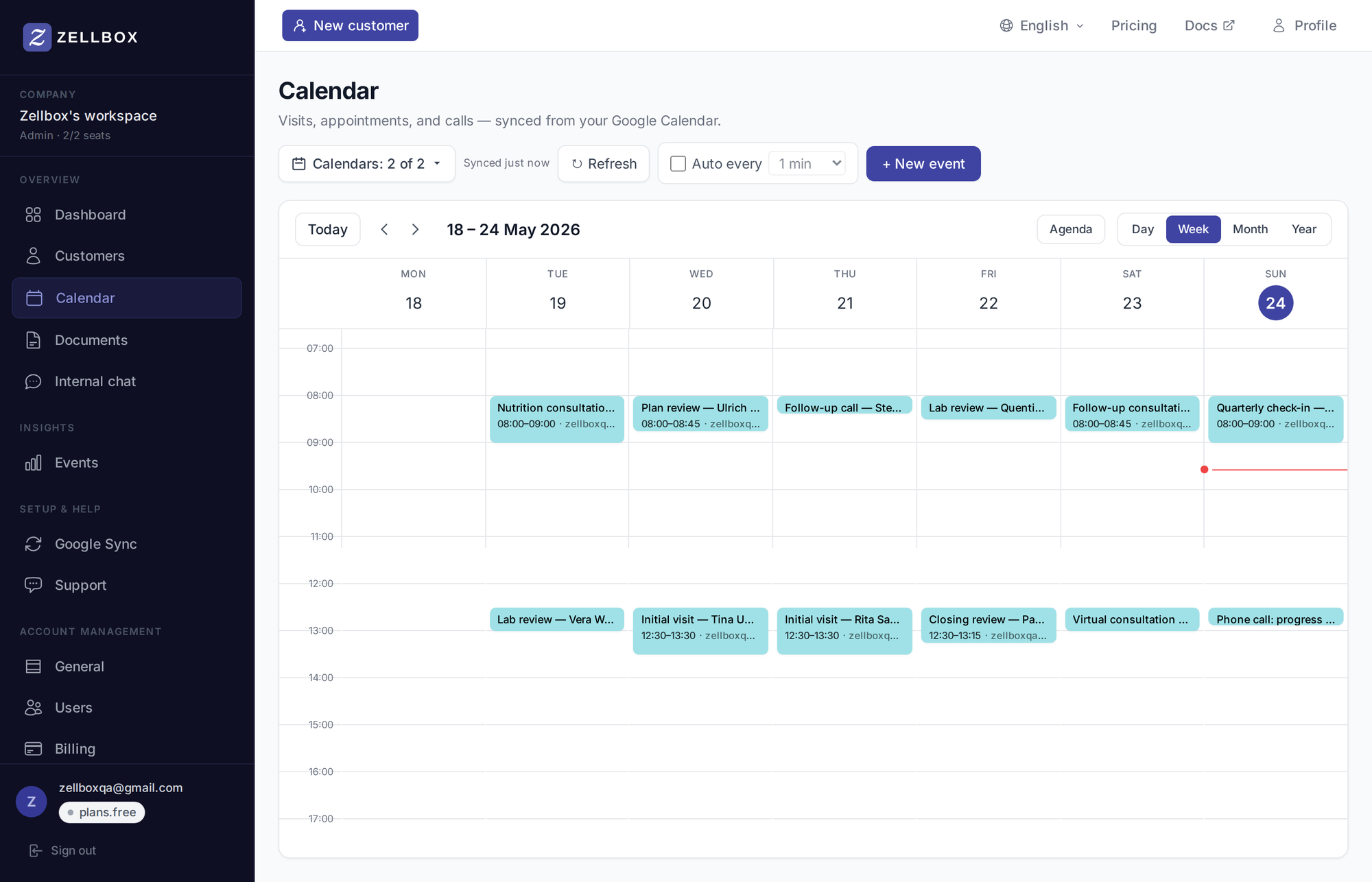
- Your existing patients have a record in Zellbox → their appointments live in your Google Calendar → WhatsApp sends reminders automatically → the shared inbox collects the replies.
- Zellbox charges on a usage basis (active patients + monthly messages).
- Main value: day-to-day operations + no-show reduction + nurturing existing patient relationships.
The two products solve different problems:
- If your problem is “too few new patients” → Doctolib.
- If your problem is “I have patients, but 12-18% don’t show up” → Zellbox.
- If you have both problems → both products in the stack.
What Doctolib does better
- Patient acquisition: Doctolib pulls in massive organic traffic. If your practice is new or you need to fill slots, Doctolib can drive direct bookings.
- Self-service booking: the patient picks a slot, sees your real-time availability, and books. No phone call needed.
- Public visibility: your Doctolib profile is indexed and shows up in searches like “dentist Munich” or “gynaecologist Berlin”.
- GDPR + sector-specific health-data compliance: Doctolib specialises in health data and is certified under the relevant frameworks.
If those are your problems, Doctolib is very likely the right call — there’s no serious substitute in Germany.
What Zellbox does better
- Native WhatsApp Business API: reminders + confirmations + cancellations over WhatsApp, the channel where 60-80% of patients actually message. Doctolib uses email + SMS — fine, but not WhatsApp.
- Two-way Google Calendar sync: an appointment the doctor moves in her Calendar updates in Zellbox, and vice versa. Doctolib has its own calendar; it doesn’t replace yours, it sits next to it.
- Shared WhatsApp inbox: the whole team can see the patient conversations. Doctolib has no equivalent.
- Multi-session treatment protocols: 5-session physio pack, annual vaccination cycle, follow-up care. Zellbox knows “session 3 of 5 of the peel, next one between July 17-24”; Doctolib thinks in single appointments.
- GDPR-compliant consent workflow with signed record: PDF signed from the patient’s phone, stored on the patient record with an audit trail. Ready for data-protection inspections.
- Usage-based pricing (not per practice): your bill scales with patients, not with practice size.
- Permanently free plan: try it with no deadline.
Coexistence is possible
The typical stack we see:
- Doctolib handles new-patient acquisition (public marketplace + available slots).
- Google Calendar is the source of truth for the practice’s appointments (the calendar the team already uses).
- Zellbox is the operational back-office: patient import, two-way Calendar sync, WhatsApp reminders, shared inbox, signed GDPR consent.
The three sit side by side. Doctolib brings the patient in; Calendar schedules the appointment; Zellbox nurtures the patient from the first visit to the tenth.
Comparison table
| Feature | Zellbox | Doctolib |
|---|---|---|
| Native WhatsApp Business API | Yes | No |
| Two-way Google Calendar sync | Yes | No |
| Public booking marketplace | No | Yes |
| Patient acquisition via SEO | No | Yes |
| Automatic WhatsApp reminders | Yes | No (email/SMS only) |
| Shared WhatsApp inbox | Yes | No |
| GDPR consent signed on record | Yes | Partial via internal flow |
| Multi-session treatment protocols | Yes | No |
| Health-data certification | No | Yes |
| Usage-based pricing | Yes | No (per practice + commissions) |
| Permanently free plan | Yes | No |
The question to ask yourself
If you run 100 appointments a week and 15% don’t show up → you lose ~15 appointments × $40-100 per week = $600-1,500/week = $2,400-6,000/month. Doctolib doesn’t solve this directly (the patient books online and still doesn’t turn up). Zellbox cuts it down with WhatsApp reminders + a 24h cancellation policy + waiting list.
If you run 30 appointments a week and the practice is new, with no visibility → you need traffic. Zellbox doesn’t solve acquisition. Doctolib does.
If you have both problems → the optimal stack is both.
Honest recommendation
| Situation | Recommendation |
|---|---|
| New practice, looking for patients | Doctolib |
| Established practice with a no-show problem | Zellbox |
| Manage WhatsApp + Calendar professionally | Zellbox |
| Appear on a booking marketplace | Doctolib |
| Both problems | Both, in the stack |
Doctolib isn’t a direct competitor to Zellbox. It’s adjacent. The practices that get the most value out of either often run both.
→ Zellbox for your sector: Pricing + sector landings. → Try Zellbox: Start for free. 12-min setup, no card. → Doctolib’s official site: doctolib.de (no affiliation).
About the author: Nacho Coll is the founder of Zellbox. He writes about WhatsApp business automation for appointment-driven SMBs.
Frequently asked questions
Is Doctolib a CRM or a marketplace?
Can I use Doctolib and Zellbox together?
What does Doctolib cost vs Zellbox?
Which one should a physiotherapy clinic pick if we already have loyal patients?
About the author
Nacho Coll
Founder & Engineer at Zellbox
Nacho founded Zellbox to give appointment-driven small businesses — clinics, salons, spas, physio, aesthetics, vets, mental-health, and fitness studios — a WhatsApp-first calendar and customer record system. Writes about WhatsApp Business automation, no-show economics, recall-cycle playbooks, and the operational realities of running visit-driven businesses at scale.