
GDPR + HIPAA checklist for clinics: 12 audit points
Twelve verifiable points an ICO or HHS OCR auditor checks in a private clinic — consents, BAAs, PHI in WhatsApp, breach notification, patient rights.
 by Nacho Coll
Nacho founded Zellbox to give appointment-driven small businesses — clinics, salons, spas, physio, aesthetics, vets, mental-health, and fitness studios — a WhatsApp-first calendar and customer record system.
Disclaimer: operational guide based on sector practice, not legal advice. For active investigations or enforcement, consult a qualified privacy attorney in GDPR (EU/UK) or HIPAA (US) healthcare compliance.
On Zellbox and HIPAA: Zellbox is not a HIPAA Business Associate today — we do not currently sign BAAs. US clinics can use Zellbox for appointment logistics (time, location, generic confirm/cancel prompts) and should keep clinical detail out of message bodies. See point 5 below for why the WhatsApp channel itself is not a HIPAA-compliant medium by default. If HIPAA-BAA support matters to your practice, tell us at hi@zellbox.com — we track demand and update this page when our stance changes.
Clinics that handle patient health data fall under two of the strictest privacy regimes in the world. In the EU and UK, the ICO and national supervisory authorities enforce GDPR with fines of up to €20M or 4% of global annual turnover. In the US, the HHS Office for Civil Rights (OCR) enforces HIPAA with civil penalties of up to $1.5M per violation category per year, plus criminal penalties for willful neglect.
Audits happen for three reasons: a patient complaint, a reported breach, or sector sampling. The 12-point checklist below is what regulators verify in a private clinic. Cover all 12 and the audit ends clean. Miss 3 or more and you face corrective action at best, a financial penalty at worst.
1. Signed treatment-specific informed consent
What: For any invasive procedure (minor surgery, laser, injectables, chemical peel, endoscopy), the patient signs a procedure-specific informed consent before session 1, explaining procedure, expected outcomes, side effects, and alternatives. GDPR Recital 35 classes this as special-category health data; HIPAA classes it as PHI under 45 CFR 164.
How to verify: open 3-5 patient records from the last 6 months. The signed PDF must be on the record with date, time, and audit trail.
Typical failure: the consent sits in a paper folder rather than on the patient record, or it never came back signed.
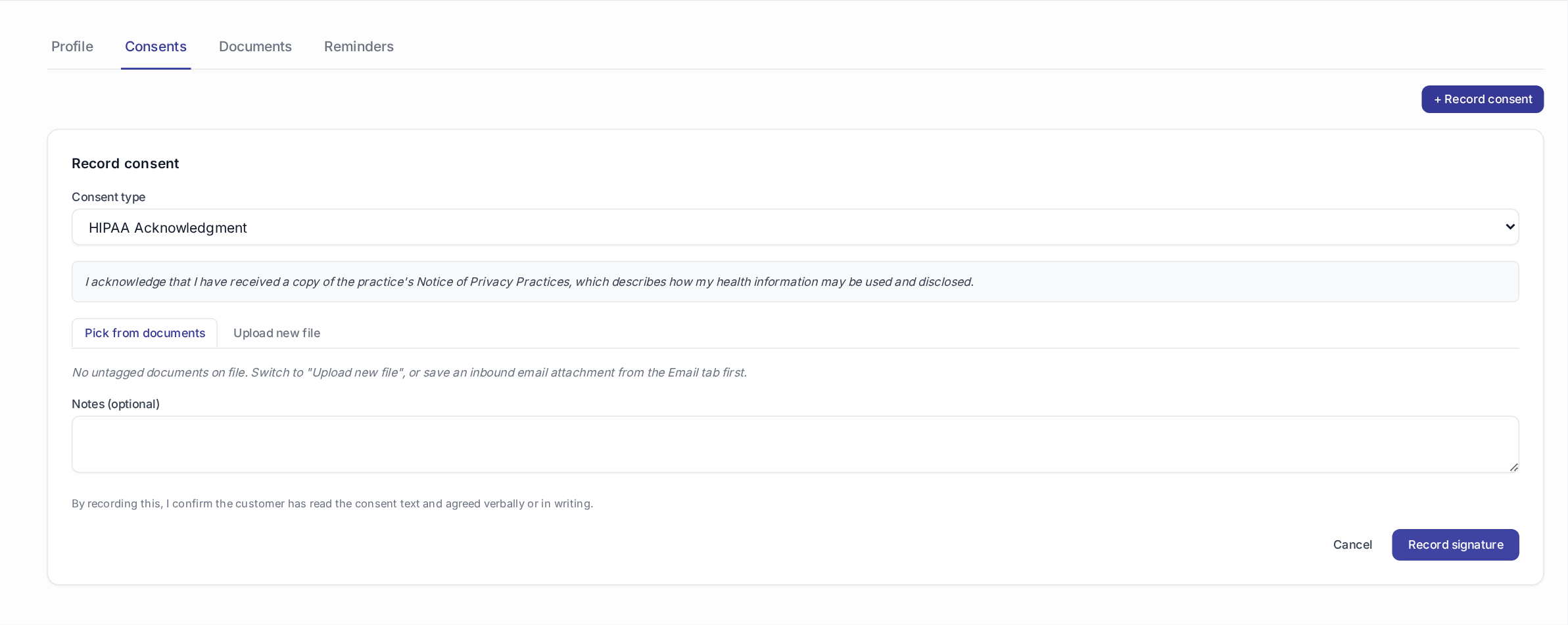
2. Documented privacy-notice acknowledgement
What: Different from procedure consent. Under GDPR Articles 13-14, every patient is informed at first contact about who controls their data, why, on what lawful basis, for how long, and with which processors. Under HIPAA, the Notice of Privacy Practices (NPP) must be provided and acknowledged in writing.
How to verify: open 3-5 new patient records from the last month. You should find a signed NPP acknowledgement (HIPAA) or a recorded privacy-notice acceptance (GDPR), dated before the first clinical visit.
Typical failure: getting it confused with treatment consent. They are two distinct documents with two distinct legal bases.
3. Separate explicit consent for marketing
What: If you send promotional content, you need a separately signed marketing consent. A generic “I agree to everything” checkbox does not work — GDPR Article 7 requires granular, opt-in, freely-given consent, and HIPAA 45 CFR 164.508 requires specific authorization for marketing uses of PHI.
How to verify: open the records of patients who receive marketing. You should find a marketing consent that is separate from the operational privacy acknowledgement, dated and timestamped.
Typical failure: everyone receives the newsletter because “they signed up at registration” — but that signature was the general privacy acknowledgement, not marketing authorization.
4. BAA (HIPAA) or DPA (GDPR) with every vendor touching patient data
What: Any external service that processes patient data — practice management software, email platform, WhatsApp provider, hosting, accounting — needs a signed BAA (HIPAA) or DPA under GDPR Article 28, specifying data accessed, purpose, and safeguards.
How to verify: list every vendor that touches patient data. For each one, you should have a signed BAA or DPA on file.
Typical failure: the clinic uses Calendly + Mailchimp + Google Workspace + Zoom + WhatsApp — and none of them are signed. Regulators ask within the first ten minutes.
5. PHI does not flow through WhatsApp (HIPAA-specific)
What: Meta’s WhatsApp Business API is not a HIPAA-compliant Business Associate by default. Meta does not sign BAAs for WhatsApp. US clinics can use WhatsApp for appointment time and location reminders, but they must keep clinical content — diagnoses, test results, treatment specifics, medication names — out of the message body. EU clinics have more flexibility under GDPR legitimate interest, but the Article 5(1)(c) minimization principle still applies.
How to verify: pull the last 50 outbound WhatsApp messages. The body should contain only the appointment time, location, clinic name, and a generic confirm/cancel prompt.
Typical failure: a clinician sends “Hi Maria, your biopsy result came back, please call us” through WhatsApp. That single message is a HIPAA breach.
6. Privacy policy linked from every page
What: Your public site must publish a privacy policy that is accessible from every page, describing the data collected, processing purposes, subprocessors, retention periods, patient rights, and the contact point. GDPR Article 13 lists the mandatory content; HIPAA requires the NPP to be posted online if the covered entity has a website.
How to verify: visit the public site. The privacy policy must appear in the footer of every page and list the actual subprocessors from your point 4 list.
Typical failure: a generic template that does not name the real subprocessors. Regulators cross-check it against your BAA / DPA register.
7. Cookie banner with prior, granular consent
What: If your site uses analytics or marketing cookies, the ePrivacy Directive and GDPR require a consent banner before any non-essential cookie loads, with accept-all, reject-all, and per-category options. HIPAA has no direct cookie rule, but OCR’s December 2022 bulletin treats tracking pixels on patient-facing pages as a PHI disclosure.
How to verify: open the site in an incognito window. The banner must appear before any analytics cookies load, and clicking reject must block them.
Typical failure: the banner displays, but Google Analytics loads anyway — common when GA4 ships without Consent Mode v2.
8. Documented patient-rights request procedure
What: Under GDPR, patients have access, rectification, erasure, restriction, portability, and objection rights — responses within 30 days. Under HIPAA, patients can access their designated record set within 30 days (extendable to 60), request amendments, and obtain an accounting of disclosures.
How to verify: is there a written procedure? A single inbox (privacy@clinic.com)? A log of requests and responses?
Typical failure: nobody knows the procedure, requests fall into the general inbox, and responses take 60-90 days — or never arrive at all.
9. Encryption in transit and at rest
What: Health data is a special category under GDPR Article 9 and PHI under HIPAA. Encrypt it in transit (TLS 1.2+) and at rest (AES-256, with keys not shared with unauthorized parties). HIPAA’s Security Rule treats encryption as “addressable”, but unencrypted PHI breaches trigger mandatory public notification under HITECH.
How to verify: does the public site serve HTTPS? Is the practice-management database encrypted at rest? If it’s SaaS, does the vendor declare AES-256 at rest in the BAA / DPA?
Typical failure: the public site is HTTPS but the internal admin tool is HTTP. Or the database is unencrypted, and a stolen server turns an incident into a notifiable breach.
10. Role-based access control
What: The receptionist does not need to see every patient’s full medical history. HIPAA’s Minimum Necessary Standard (45 CFR 164.502(b)) and GDPR’s data-minimization principle both require role-segmented access.
How to verify: open the system as the receptionist. If you can see clinical notes, segmentation is missing.
Typical failure: every user has access to everything. Acceptable in a solo practice but a guaranteed finding in clinics with 5+ staff.
11. Record of processing activities + security risk analysis
What: GDPR Article 30 requires a written Record of Processing Activities (ROPA) — name, purpose, lawful basis, data categories, retention, safeguards. The HIPAA Security Rule (45 CFR 164.308(a)(1)) requires a Security Risk Analysis — what PHI you hold, where, threats, mitigations. A typical private clinic ends up with 8-15 entries in each.
How to verify: do the documents exist? Have they been updated in the last 12 months? Can the practice owner produce them within 5 minutes?
Typical failure: it was never created. OCR’s enforcement database shows that “no Security Risk Analysis” is the single most common finding behind HIPAA penalties — including the $4.3M Cignet Health and $5.5M Memorial Healthcare settlements.
12. Breach notification plan with defined timelines
What: GDPR Article 33 requires supervisory authority notification within 72 hours. HIPAA’s Breach Notification Rule requires individual notice within 60 days, HHS notification (annually under 500 records, within 60 days over 500), and media notification for breaches over 500 in a state.
How to verify: is there a written plan? Who handles the notification (DPO under GDPR, Privacy Officer under HIPAA)? Is there a template ready to send?
Typical failure: nobody thought about it until the incident. Notification slips past the 72-hour / 60-day window, which multiplies the eventual penalty.
Real penalty figures from the public record
These are not theoretical caps — they were actually imposed:
- Anthem Inc. (HIPAA, 2018): $16M OCR settlement for a breach affecting 78.8M individuals.
- Memorial Healthcare System (HIPAA, 2017): $5.5M for impermissible PHI access by 12 employees.
- British Airways (GDPR, ICO, 2020): £20M for a 400,000-customer breach — a health-sector parallel when PHI is involved.
- Clinique La Prairie (CNIL, 2023): €36,000 plus a public reprimand against a private clinic for a missing DPA with a marketing vendor.
How Zellbox covers the 12 points by default
Zellbox was built from day one to map to both GDPR and HIPAA-style requirements for private clinics:
- Signed consents (1, 2, 3) — sent from the patient record, signed on the patient’s phone, and stored as a signed PDF on the record with a full audit trail. Operational and marketing consents are kept as two separate documents with separate lawful bases.
- DPA register (4) — Zellbox signs a Data Processing Agreement with EU customers; the subprocessors (AWS, Meta, Google, Stripe) are listed publicly. On the HIPAA side, Zellbox is not a Business Associate today — we do not sign BAAs, and Meta’s WhatsApp Business API cannot back one either (see point 5). US healthcare practices should scope Zellbox use to appointment logistics that fall outside the PHI boundary.
- WhatsApp content minimization (5) — templated reminders carry the appointment time and location only; clinical content goes through email or signed-document delivery instead.
- Privacy policy + cookie banner (6, 7) — a customizable privacy policy template with your legal identity and actual subprocessors, plus a Consent Mode v2 compatible banner.
- Patient rights workflow (8) — a built-in endpoint for access / rectification / erasure requests with a full audit trail.
- Encryption in transit and at rest (9) — TLS 1.2+ end to end, AES-256 at rest with dedicated KMS keys per customer.
- Role-based access (10) — admin and member roles with field-level controls on clinical notes.
- ROPA + risk analysis templates (11) — pre-filled templates for the processing operations typical of a private clinic.
- Breach notification flow (12) — a built-in 72-hour notification procedure routed through your DPO or Privacy Officer.
→ Start free with Zellbox (free plan, no card) → Zellbox privacy policy — reference model for your own → No-show calculator — what reminder failures cost per month
The straight summary
ICO and OCR audits are not bad luck. They happen because (a) a patient complained, (b) a breach was reported, or (c) the clinic was sampled. The first two are avoidable with operational hygiene; the third is pure probability, and only the prepared clinics come through cleanly.
If the 12 points are covered before an auditor arrives, the audit ends clean. Miss 3 or more and you face corrective action at a minimum, or six- or seven-figure fines at worst — regardless of clinic size.
The difference between real and apparent compliance comes down to whether consents are signed and attached to the patient record (real) or sitting in an unscanned paper folder (apparent — and apparent compliance always fails the first audit).
About the author: Nacho Coll is the founder of Zellbox. He writes about WhatsApp Business automation for appointment-based SMBs.
About the author
Nacho Coll
Founder & Engineer at Zellbox
Nacho founded Zellbox to give appointment-driven small businesses — clinics, salons, spas, physio, aesthetics, vets, mental-health, and fitness studios — a WhatsApp-first calendar and customer record system. Writes about WhatsApp Business automation, no-show economics, recall-cycle playbooks, and the operational realities of running visit-driven businesses at scale.